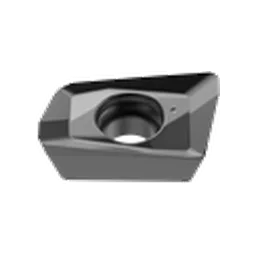
AOHT 120408 Milling Inserts
Compare suitable materials and applications, then choose a brand to view the exact SKUs.
- ISO Code
- AOHT120408
- Insert Size
- 120408
- Shape
- A
Find the Right Option
Select the workpiece material and application. Brand remains optional.
Brands
All available options for this parent model.
AOHT 120408 — 85° parallelogram milling insert, 2 edges, Steel, Stainless steel, Cast iron, Non-ferrous. There are currently 6 variants in stock from Achteck. Measured across the range: 8.15 mm inscribed circle, 5.07 mm thickness, 0.8 mm nose radius.
Milling inserts are chosen to match the cutter body — lead angle, number of teeth and the geometry designated by the manufacturer. The milling insert selection guide walks through that; this page lists what we actually hold in AOHT 120408.
Geometry and dimensions
| Insert family | AOHT |
|---|---|
| Category | Milling Inserts |
| Shape | 85° parallelogram (A) |
| Usable cutting edges | 2 |
| Inscribed circle (IC) | 8.15 mm |
| Thickness (S) | 5.07 mm |
| Nose radius (RE) | 0.8 mm |
| Cutting edge length (L) | 11.3 mm |
| Fixing hole diameter (D1) | 3.9 mm |
| Hand | Right |
| Variants in stock | 6 |
| Brands | Achteck |
Cutting data
The 6 variants of AOHT 120408 listed here are supplied without a full published cutting-data set, so we do not publish one. Ask us for the specific grade and chipbreaker you are considering and we will send the manufacturer's window for it.
Carbide grades available
6 variants of AOHT 120408 are stocked in these grades: AW100K, AP251K, AP251U, AP351M, AP403M, AP403S.
Across this range the grades specified most often are AW100K, AP251K, AP251U, AP351M, AP403M. Within one brand's range, a higher middle digit usually means a tougher grade — better on interrupted cuts, slightly less wear resistant. See carbide grades explained for how to read the names.
Chipbreaker geometries
Chipbreakers stocked for AOHT 120408: MM3, FM2.
For milling, the geometry code marks the intended duty — sharper for light cuts and better finish, stronger for scale and interruption. Milling insert selection guide.
Typical applications
- Shoulder Milling
- Face Milling
- Slot Milling
- Ramp Milling
- Helical Interpolation
- Pocket Milling
For more on cutting steel, see our material-specific guide.