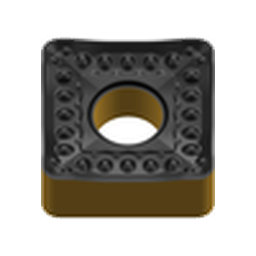
SNMM 190624 Turning Inserts
Compare suitable materials and applications, then choose a brand to view the exact SKUs.
- ISO Code
- SNMM190624
- Insert Size
- 190624
- Shape
- S
Find the Right Option
Select the workpiece material and application. Brand remains optional.
Brands
All available options for this parent model.
SNMM 190624 is a square 90° turning insert with 8 usable cutting edges, used mainly for heavy roughing, square shoulders and interrupted cuts. We list 13 stock-keeping variants of it from Achteck, covering Steel.
The designation encodes the geometry: the first letter is the shape (S), the following letter the clearance angle, then the tolerance class, then size, thickness and nose radius. If you want to check any of it, our ISO insert code decoder breaks the full string down character by character.
Geometry and dimensions
| Insert family | SNMM |
|---|---|
| Category | Turning Inserts |
| Shape | square 90° (S) |
| Usable cutting edges | 8 |
| Inscribed circle (IC) | 19.05 mm |
| Thickness (S) | 6.35 mm |
| Nose radius (RE) | 2.4 mm |
| Fixing hole diameter (D1) | 7.94 mm |
| Hand | Neutral |
| Variants in stock | 13 |
| Brands | Achteck |
Recommended cutting data
The figures below are the manufacturers' published ranges, aggregated across the 13 variants listed on this page. The typical column is the median, which is where most shops end up running. Treat the full range as the envelope, not a target — start around 60–70% of it and work up.
| Workpiece material | Cutting speed vc (m/min) | Typical vc | Feed fn (mm/rev) | Depth of cut ap (mm) | Variants with data |
|---|---|---|---|---|---|
| Steel (P) | 45 – 620 | 75 – 510 | 0.48–1.44 | 4.32–11.43 | 13 of 13 |
To turn a cutting speed into a spindle speed for your actual diameter, use the cutting parameters calculator: n = vc × 1000 / (π × D).
Carbide grades available
13 variants of SNMM 190624 are stocked in these grades: AC350P, AC052P, AC152P, AC252P.
Across this range the grades specified most often are AC350P, AC052P, AC152P, AC252P. Within one brand's range, a higher middle digit usually means a tougher grade — better on interrupted cuts, slightly less wear resistant. See carbide grades explained for how to read the names.
Chipbreaker geometries
Chipbreakers stocked for SNMM 190624: PD8, PC9, PD9.
The chipbreaker sets the usable feed window far more than the depth of cut does. A roughing geometry run at finishing feed will not break the chip; a finishing geometry pushed into a roughing cut will chip. Match it to the feed you will actually run — chipbreaker selection guide.
Typical applications
- Roughing
For more on cutting steel, see our material-specific guide.
Choosing the right SNMM 190624
Three things decide which variant you need:
- The workpiece material group. This page lists variants published for Steel. Pick a grade from the group you are cutting — a steel grade on a superalloy will fail quickly.
- Feed, not depth of cut. The chipbreaker is defined by its feed window. Decide the feed first, then pick the geometry that covers it.
- Nose radius versus finish. SNMM 190624 is stocked here at 2.4 mm. A larger radius gives better finish at the same feed and a stronger edge, but raises cutting force.
Not sure whether SNMM 190624 is the right shape at all? The turning insert selection guide compares shapes by what the part profile allows.
Frequently asked questions about SNMM 190624
What size insert is SNMM 190624?
SNMM 190624 has an inscribed circle of 19.05 mm and a thickness of 6.35 mm. As a rule the depth of cut should stay under about two thirds of the inscribed circle.
What nose radius does SNMM 190624 have?
The nose radius (the last two digits of the designation) is 2.4 mm on the variants listed here. Surface roughness scales roughly with fn²/(32 × RE), so at a fixed feed a larger radius halves Ra.
Which holder does SNMM 190624 fit?
The holder designation must carry the same shape letter (S) and the same size digit. Send us your holder code and we will confirm the match before you order.
How many SNMM 190624 variants do you stock?
13 variants from Achteck, listed below with grade, chipbreaker and the published cutting data where the manufacturer provides it.
What cutting speed should I run for SNMM 190624?
For Steel, the published range across these variants is 45–620 m/min, with a typical window of 75–510 m/min. Heavy cuts sit at the bottom of that range, light finishing cuts at the top.